Pennsylvania Thoroughbred has a new home - at Wordpress, where you'll be able to find history and news from the mid-Atlantic region.
Find Pennsylvania Thoroughbred now at http://pathoroughbred.wordpress.com/ and thanks for reading!

The good 'ole days at Liberty Bell Park in northeast Philadelphia
Saturday, June 8, 2013


Friday, May 17, 2013
More from the "Cherry and Black"
Today we continue our exploration of
the wonderful old book “Cherry and Black: The Career of Mr. Pierre Lorillard on
the Turf,” by W. S. Vosburgh, printed in 1916. In it, a visitor (presumably
Vosburgh) details a trip to Rancocas Stud in Jobstown, N. J., where Lorillard
established his 1,500- acre thoroughbred nursery, as well as chronicles the racetrack exploits
of Lorillard’s stable.
Among the following passages, the
author describes the stallion Mortemer, a grand French stayer who came to the
United States at age 15 after a successful stud career in France, and stood at
Rancocas until he was 21. He was moved to nearby Brookdale Stud before his
death in June, 1891. You can read more about Mortemer here:
On
a slight elevation facing the south stands a huge glass house, a crystal palace
which but for its height might be mistaken for a greenhouse. It is the
"Playhouse" in Rancocasan vernacular— a sort of kindergarten, where
the weanlings are turned out during the winter. It is not used until the frost
sets in, but the weanlings had been kept in this morning to afford us an
opportunity for close inspection before they were turned loose in the paddock.
This
mammoth glass building is 350 feet in length by 250 in width. The floor is
covered with sand which never freezes and allows the youngsters full scope to
play and romp during the coldest days in winter.
As the door is opened the sight is bewildering. Thirty-three colts and fillies are at play, mostly Mortemers and mostly chestnuts. They were but recently weaned, and the brown mare Hildegarde was still with her foal, a brown filly foaled late in June. It is difficult to form an opinion in such a constantly moving throng, but a chestnut colt from Highland Lassie was among the most forward—"an early foal— Feb. 18," we are told.

The French racehorse and stallion Mortemer (http://www.antonioraimogalleries.com/shop/raimo/5523.html)
Mortemer was standing like a statue in his yard. There is something impressive in the personnel of "the mighty Frenchman." Massive, stately and imperious, he looks a king among horses. A deep red chestnut with a narrow, divided blaze, he stands 16.2 h, measures 73 inches girth; his arm at the swell, 19 inches; below the knee, 8 inches. His shoulder-blade is 32 inches in length; and from hip to hock he measures 42 inches. His off forefoot has given them some trouble, otherwise he carries his age well and is as gentle as a dog. In his first season here he had 40 foals from the 46 mares with which he was mated.
Tuesday, May 14, 2013
Rancocas Stud - the "Cherry and Black"
One of the more enjoyable rides I
take several times a year is through Jobstown, N. J., on my
way to Cream Ridge. The highlight of the trip is always seeing Helis Stock Farm
off to the left, the ornate gate and buildings of what used to be historic
Rancocas Stud.
Many articles have been written about
Pierre Lorillard’s once majestic thoroughbred nursery, but recently I stumbled
across a buried treasure thanks to the newly-opened vault called the Digital
Public Library of America. There, I found the entire text of the book “Cherry and Black: The Career of Mr. Pierre
Lorillard on the Turf,” by W. S. Vosburgh. The frontspiece of the book states
that it was “Printed for Pierre Lorillard” in 1916.
That the farm still exists today,
though not for thoroughbred racing and breeding purposes, is nothing short of a
miracle, given the rate that the surrounding land in Burlington County has been
bulldozed for development.
Back in the late 1800’s, Rancocas
Stud was established by Lorillard, a Gilded Age tobacco millionaire, and named
after the Rancocas Creek, which runs through the property. Its 1,500 acres was home to an indoor training
barn and outdoor training track, a manor house, multiple barns and homes for
workers, and an iron front gate with winged Mercury emblazoned upon it (see
photo, below) that he brought from the Bowery Bank in New York. Many of these structures still stand today. It reportedly
cost Lorillard more than $1 million to build the farm.

Here’s an excerpt from “Cherry and
Black” that describes Rancocas from a visitor’s point of view circa 1890:
We
had kept late hours, and the sun was shining when we awoke. All was astir as we peeped from
our window and viewed the spreading acres of the estate, which sank with the
horizon, in the golden mist of the October morning.
Men
were coming and going and the roll of wagons told that the day's work had
begun. Presently we see a string of eight horses trotting on the training
track. They are yearlings. The sight is too much for a racing enthusiast; we
dress hastily … The track covers three quarters of a mile, with easy turns, and
here it was that Saxon and Attila learned their lessons, and Parole and Iroquois
were first put through their paces.
A
big brown two-year-old is leading as "schoolmaster" to a lot of yearlings,
and Endymion brings up the rear. But the gentlemen are on the veranda, and we
are reminded that breakfast
is served.
One
can form little idea of the magnitude of Rancocas by a casual glance. The farm
covers 1500 acres, mostly meadow land. It is slightly undulating, on a somewhat
sandy stratum, which insures
good drainage. Of its stock operations it need only be stated that it consumes
20,000 bushels
of oats per annum, and 7,000 bushels of carrots. The stud consists of eighty
broodmares, eight stallions, forty-eight horses in training, including
yearlings, and forty-four weanlings, not to speak of a large number of
half-breds and horses for general use.
The
cattle are exceptionally fine, and the sheep and Berkshire pigs are strong in
numbers.
But
it is not in live stock alone that Rancocas can boast its productions. The
nurseries are among the finest in the land. Strawberries, cucumbers, tomatoes,
and melons are to be had ripe and juicy in and out of season; while the cellar,
constructed for the production of mushrooms, is quite a model of its kind. The
floral productions comprise roses of varied shade and perfume, and water-lilies
of delicate hue peep out from their hiding-places, while rare exotics from
distant points of the Orient and the Occident grow side by side in profusion.
The
training stable is circular in shape, and within is a walking ring for winter
work on the straw-bed, and well sheltered by the boxes surrounding it.
The
horses are out, and old Parole leads, looking rough and ready as he rolls his eye at us.
Herbert follows, "a plain horse but a good doer"; Barrett lays back
his ears in sullen disdain, as though he overheard some remarks from the
company of his being “a Derby disappointment."
Pizarro,
"the Lincolnshire beauty," dances gaily in the sunlight as he passes,
looking
more robust than
when he last bore the "cherry" jacket. Gonfalon, a burly brown, and
little Nimrod jog along demurely. Spartacus we hardly fancy, but Amazon, a
lovely filly, prances and dances with excess of spirits. Venetia follows, and
then Disdain. Inconstant, Breeze and Battledore come along in Indian file,
quite a corps d'elite, comprising winners of the Atlantic, August, Red Bank, Optional,
Breeders, and Champagne Stakes. Hiawasse is enjoying the "rest cure"
in her box, round as a ball, and few would recognize the winner of the Monmouth Oaks, Ladies,
and Mermaid Stakes but for her familiar Vandal head and long ears.
To
be continued …
Thursday, March 28, 2013
Beauty's in the Eye of the Beholder
Here’s another gem from the Keystone
Racetrack archives, this time courtesy of the Philadelphia Tribune from
September 29, 1978, a little less than four years after the Bensalem course
opened. It’s interesting to read about the way things were 35 seasons ago –
there was a distinct beginning and ending to the season, and there was little
overlap in race dates in the mid-Atlantic region, leading to an abundance of
horses and jockeys.
The
article is entitled: “Keystone Preview: Cosmetic Improvements Heighten Racing
Fun,” and there is no byline. Methinks the author, whomever he/she was, may have
been embellishing things a bit. After all, the track was built hastily upon
land that was once a pig farm (this is no joke!).To illustrate, there will be twin lakes in the infield. There will be a 10-foot wide canal connecting the two bodies of water and bridging the canal in the emerald infield will be an attractive gazebo.

There are other cosmetic improvements. Floral beds with emphasis on red parenthesize the tote board. Two canopies offer cover and color to patrons arriving by public transportation and for those with a preference for valet parking.
MOREOVER, ASIDE from adding a second lake and other eye pleasers since the previous season closed in May, Keystone has constructed a large outdoor walking ring, enlarged the paddock and increased the depth of the area between the paddock and the entrance to the stands.

Nice. Very nice. But what about the
horses?
As the only major track in operation
(Atlantic City will close before Keystone opens) south of East Rutherford, N. J.
and north of Maryland, Keystone has the pick of runners that have campaigned at
Atlantic City, Delaware Park, Monmouth Park, and other points.Racing secretary Larry Craft received applications for stalls for more than 3,000 horses. The best were accepted. Many others have subsequently been situated within easy vanning distance of Keystone.
THE PREFERENCE trainers show for Keystone is a tribute to this track which offers a marvelous racing surface and a rich purse structure.
Four outstanding trainers – Danny Lopez, Marty Fallon, Jay Walton and Bobby Camac – were accepted at Meadowlands but chose to come here. Lopez was co-champion at Meadowlands last season, too. Fallon, incidentally, had an outstanding meet at Meadowlands.
The stables of these trainers were among the first to bed down at Keystone. Other early arrivals include the runners of Dan Hasbany, Dave Vance, Dennis Heimer, C. W. (Charles) Baddeley and Dr. John R. S. Fisher.
Hasbany recently captured the New England championship. Vance, of course, leads all trainers in career triumphs at Keystone with 342.
Virtually all of the successful jockeys in past meets at Keystone will be back. In addition, Larry Snyder, the Midwestern standout, will be here to ride the stars of Del Carroll’s stables.
POST TIME will be 1:30 p.m. through October 28. Racing will be held every Sunday during the meeting which will run until the end of May, 1979.
Each day’s program will be made up of nine races. Wagering will include the daily double, six exactas and two trifectas as well as win, place and show betting.
Sunday, March 24, 2013
A long-lost racetrack in northeast Philadelphia

A
subject which has always greatly interested me is that of long-gone and
little-known racetracks, especially those in Pennsylvania and New Jersey.
Thus, when I learned that there was
a harness oval located not far from where I live in northeast Philadelphia, I
couldn’t wait to do a little research about it.
The New Philadelphia County Fair at
Byberry conducted its first race in 1912 and continued until the late 1920s. It
was located on the south side of modern-day Byberry Road, west of Roosevelt
Boulevard and the Short Line Railroad, behind the old Somerton Fire house.
Harness racing, plus the judging of
farm animals, produce, preserves and baked goods were all part of the County
Fair. There was a half-mile race track, two large buildings, and a grandstand
on 100 acres.
Sadly, the land upon which the
Philadelphia County Fair once stood is now a mish-mosh of single homes,
rowhomes, and businesses.
The following photo of a postcard from
the Library Company of Philadelphia Print Dept. depicts a plethora of County Fair
buildings and activities. In the background are the Women’s Building, Crane’s
Ice Cream stand, Crackerjack the Mexican and Sealskin Horse, and a station for
automobile maintenance.

Friday, March 22, 2013
From the pen of Red Smith
Believe
it or not, the renowned sportswriter Red Smith actually wrote about Keystone
Racetrack, way back on December 13, 1974, in the New York Times.
In
this article, entitled “Weekend of
Brotherly Sin,” Smith discusses the Bensalem, Pa. oval’s foray into Sunday
racing, with a little Pennsylvania horse racing history tossed in for good
measure.

Walter
Wellesley “Red” Smith, in case you’ve never heard of him, was a Pulitzer
Prize-winning journalist and one of America's most widely read sports
columnists.
Here’s
an excerpt from his column about Keystone:
One-month-old Keystone Race Track in
Cornwells Heights, Bensalem Township, Bucks County, Pa. is the youngest
gambling hell in the land but already far gone in wickedness. There on the
outskirts of staid Philadelphia, and nowhere else in America this year, a man
can win a $100,000 race and lose his immortal soul on the same weekend. The
Heritage Stakes, the last $100,000 event in this country for 1974, will be run
there tomorrow afternoon, and 24 hours later Keystone will conduct its first
program of Sunday racing, plunging the community headlong into sin. It is
curious that Philadelphia, “the most pecksniffian of American cities,”
according to Henry L. Mencken, should precede New York into iniquity, but by
the time Belmont and Saratoga start desecrating the Sabbath next summer,
horseplayers in William Penn’s greene countrie towne will be hardened
characters, probably beyond redemption.
As
human depravity is measured, it was only yesterday that Pennsylvania lowered
its standards to permit such profane pursuits as baseball and fishing on
Sunday. This just goes to show what happens when the first crack in the dike
goes unrepaired.
Next thing straitlaced old
Philadelphia knows, she’ll be wallowing as deep as sin as she did in her
earliest, purplest past. Though it is seldom remembered today, Penn himself had
been in the slammer several times before he even saw America, and the town he
founded was no better than she should be. As early as 1699, in fact, Penn
imported the stallion Tamerlane and two mares to Philadelphia. A decade before
the American Revolution his grandson, Richard, was president of the
Philadelphia Jockey Club, easily the fanciest such organization in America,
candidly created “to promote the Pleasures of the Turf.”
It is frequently related how young
bucks of Ben Franklin’s time endangered pedestrians by racing horses up and
down Sassafras Street and persisted in this reckless behavior in the face of
municipal disapproval until the thoroughfare came to be known as Race Street,
the name it still bears.
The Gallows Game
That wasn’t Philadelphia’s first race
course, however. An earlier one is described thus by William H. P. Robertson in
his “History of Thoroughbred Racing in America”:
“Penn’s plans for the City of Brotherly
Love included a group of vacant squares intended as public recreation grounds,
and one of these areas, Centre Square, was frequently used for racing, accounts
of which include a description of horses ‘dodging in and out among the trees.’
(The trees might have been somewhat preferable, at that, to the Square’s later
accoutrements; Hervey reports that when it was cleared and converted into a
common, the Square was utilized for public hangings, and the horses raced
around a gallows which stood in the infield.).”
Penn was both a racing man and a
breeder and he noted in his “Reflexions and Maxims” that “men are more careful
of the breed of their horses and dogs than of their children.”
The first Sunday program in
Pennsylvania consists of three allowance races and six claimers. Daylight being
a trifle skimpy this season, first post at Keystone is 12:30 p.m. on weekdays,
but the law says 1 p.m. on Sundays. In Colonial days, Maryland forbade racing “near
the nearby meetings of the people called Quakers.” Today Pennsylvania forbids
it until Quakers get out of meeting and make it to the mutuel windows.
Red Smith
Monday, March 18, 2013
A dark day in northeast Philly, circa 1986
As promised, we present another article from the archives, this time courtesy of the Philadelphia Daily News. Entitled "Track Buyer: Off-Price is Best Bet," and dated May 13, 1986, it describes the deal made to sell the financially troubled and shuttered Liberty Bell Park in far northeast Philadelphia to a developer.
A key paragraph perhaps sums it up best, when the realtor representing track owners stated: "We've been marketing the property nationally and internationally for more than six months now. There was very little interest in reactivating the site for racing entertainment. In fact, it was almost non- existent."
Unfortunately for me, I live right down the street from the monstrosity now known as Franklin Mills Mall. Today, 27 years later, the Mall is a magnate for thieves and low-lives, and I often wish it was still a racetrack. It was built hastily and without any rhyme or reason, desecrating the land upon which thoroughbreds and standardbreds once trod.
RIP Liberty Bell Park.
The owner of Liberty Bell Park yesterday agreed to sell the racetrack for $23.3 million to a Washington, D.C., development company that has tentative plans to build a shopping center on the Northeast Philadelphia site.
Liberty Bell Park Inc., the track's corporate owner, plans to sell the 288- acre property to Western Development Corp., which has preliminary plans to build a large commercial development at the track, located at Knights and Woodhaven roads. A 1-million-square-foot shopping mall, specializing in discount stores, would anchor the project.

A key paragraph perhaps sums it up best, when the realtor representing track owners stated: "We've been marketing the property nationally and internationally for more than six months now. There was very little interest in reactivating the site for racing entertainment. In fact, it was almost non- existent."
Unfortunately for me, I live right down the street from the monstrosity now known as Franklin Mills Mall. Today, 27 years later, the Mall is a magnate for thieves and low-lives, and I often wish it was still a racetrack. It was built hastily and without any rhyme or reason, desecrating the land upon which thoroughbreds and standardbreds once trod.
RIP Liberty Bell Park.
Track Buyer: Off-price Is Best Bet
The owner of Liberty Bell Park yesterday agreed to sell the racetrack for $23.3 million to a Washington, D.C., development company that has tentative plans to build a shopping center on the Northeast Philadelphia site.
Liberty Bell Park Inc., the track's corporate owner, plans to sell the 288- acre property to Western Development Corp., which has preliminary plans to build a large commercial development at the track, located at Knights and Woodhaven roads. A 1-million-square-foot shopping mall, specializing in discount stores, would anchor the project.
A final sale depends upon a number of conditions, including re-zoning of the property to permit mixed-use development, said Neil Heyse of Cushman Wakefield, the real estate firm representing Liberty Bell Park Inc.
People who live near the track are likely to oppose such a zoning change, said Councilman Brian J. O'Neill. Track owners planned to meet last night with O'Neill and several neighborhood representatives to hear the residents' concerns related to the sale and the development proposal.
O'Neill said he has told the track owners to "expect a hard sell."
"The people in this community were very much hoping to get a racetrack again," he said. Nearby residents don't care about the extra city tax revenue that a big commercial project would create, he said, because they don't feel their taxes buy adequate city services. The big concern, he said, will be the impact on local traffic.
"The project is going to have to be sold on its merits, and it's going to have to be sold to a community that is already congested and doesn't want any more traffic," O'Neill said.
The track has been closed since August 1985. Liberty Bell Park Inc. tried to sell the parcel to another track operator, Heyse said, but that option died when it became apparent that reopening the track did not make financial sense. Liberty Bell has been losing more than $1 million a year for several years, he said.
"We've been marketing the property nationally and internationally for more than six months now," he said. "There was very little interest in reactivating the site for racing entertainment. In fact, it was almost non- existent."
O'Neill, however, said one track operator agreed to meet the property's original $20 million asking price, with a few conditions. The new owner wanted to keep $6 million in tax write-offs accumulated by Liberty Bell Park Inc. and be granted the right to develop a portion of the land for commercial use. Western Development, O'Neill said, apparently came up with a better offer.
Heyse blamed most of the track's problems on the burgeoning casino industry in Atlantic City. Local tracks have a hard time competing with the casinos for gambling dollars, he said. Heyse said Western Development's proposal represents the most logical use for the site.
Liberty Bell Park before (right) and after, as Franklin Mills Mall (left).
Thursday, March 14, 2013
Keystone Kapers
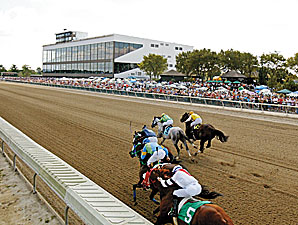
While doing a little digging through the library archives, I ran across an interesting series of articles written in the 1970's about Keystone Racetrack. Keystone, hastily built in 1974 on a pig farm in Bensalem Township, Pa., was the heir apparent for Liberty Bell Park in northeast Philadelphia, which was experiencing severe financial difficulties and would close in 1985. That year, Keystone's name was changed to Philadelphia Park, which eventually morphed into the oddly-named "Parx" in 2010.
Beginning today, I am going to present these articles in an effort to dredge up a bit of history about the "big box on Street Road," as it was fondly referred to. This first one, dated Oct. 24, 1976, boasted the headline: "Racing Secretary Gabriel Fired."
PHILADELPHIA, Oct. 23 (AP) - Keystone Race Track Racing Secretary Frank Gabriel has been fired following an admission that he tampered with post positions for the $25,000 Doylestown Handicap.
Gabriel admitted arranging for Foxy J. G., a Pennsylvania-bred mare, to get the extreme outside post position. Foxy J. G. does poorly racing on the inside. Gabriel has been racing secretary at the track since its opening in November 1974. He was secretary at Maryland's Laurel Race Course before coming to Pennsylvania.
Perhaps most notable about this article is the fact that the track now runs the Foxy J. G. Stakes for Pennsylvania-bred fillies and mares each year. Foxy J. G. became a foundation broodmare for the Castle Rock Farm in West Chester, as her daughter, Farah Foxet, became the dam of the multiple stakes-winning sprinter Power By Far.
Gabriel had a long career in racing, and passed away in 2005 at age 81. Here's his obituary notice, courtesy of The Blood-Horse: http://www.bloodhorse.com/horse-racing/articles/26940/retired-racing-official-frank-gabriel-sr-dies
Beginning today, I am going to present these articles in an effort to dredge up a bit of history about the "big box on Street Road," as it was fondly referred to. This first one, dated Oct. 24, 1976, boasted the headline: "Racing Secretary Gabriel Fired."
PHILADELPHIA, Oct. 23 (AP) - Keystone Race Track Racing Secretary Frank Gabriel has been fired following an admission that he tampered with post positions for the $25,000 Doylestown Handicap.
Gabriel admitted arranging for Foxy J. G., a Pennsylvania-bred mare, to get the extreme outside post position. Foxy J. G. does poorly racing on the inside. Gabriel has been racing secretary at the track since its opening in November 1974. He was secretary at Maryland's Laurel Race Course before coming to Pennsylvania.
Perhaps most notable about this article is the fact that the track now runs the Foxy J. G. Stakes for Pennsylvania-bred fillies and mares each year. Foxy J. G. became a foundation broodmare for the Castle Rock Farm in West Chester, as her daughter, Farah Foxet, became the dam of the multiple stakes-winning sprinter Power By Far.
Gabriel had a long career in racing, and passed away in 2005 at age 81. Here's his obituary notice, courtesy of The Blood-Horse: http://www.bloodhorse.com/horse-racing/articles/26940/retired-racing-official-frank-gabriel-sr-dies
Monday, February 25, 2013
In the heart of Cream Ridge
Judith Jannuzzelli’s Birch Creek Farm
in Cream Ridge, N. J. was the scene of a Stallion Showcase and Open House
yesterday, February 24.
A good crowd of owners, breeders,
trainers and just plain horse lovers were in attendance to inspect the farm’s three
stallions. Standing their second season at Birch Creek are March to Victory, a stakes-placed son of Dixieland Band from the family of sire Silver Hawk, as well as multiple winner Il Postino, a son of Distorted Humor and a half-brother to graded stakes winner Awfully Smart.
Both March to Victory and Il Postino are owned by Law Legacy Stables, LLC, and stand for $1,000, live foal, with special consideration to mares foaling in New Jersey and/or multiple mares.
A newcomer to the Birch Creek roster is Freud’s Honour, a blaze-faced son of Freud who won the Choice Stakes at Monmouth Park and was voted champion 3-year-old colt in New Jersey in 2011.
Owned by Joe Rivera, Freud’s Honour earned more than $226,000 in three seasons of racing. He stands for $2,000, live foal, with special consideration to mares foaling in New Jersey and/or multiple mares and stakes winners/producers.
Birch Creek, a beautiful facility in the heart of New Jersey’s horse country, is managed by Denise Jannuzzelli-Williams.
Here are some photos from the Stallion Showcase:

Freud's Honour, a son of Freud-Act of Glory, by Honour and Glory

Il Postino, a son of Distorted Humor-Awful Smart, by Black Tie Affair (IRE)

March to Victory, a son of Dixieland Band-Frayne, by Red Ransom
Saturday, February 23, 2013
Weekend notes
The
Open House scene in Pennsylvania and New Jersey has dwindled down over the
years to a scant few farms, but if you’re in the mood to see a beautiful
establishment and some nice horseflesh why not take a trip to Cream Ridge, N.
J. for Birch Creek Farm’s Stallion Showcase this Sunday, Feb. 24, from noon
until 3 p.m.
Birch Creek, managed by Denise
Williams, is standing three stallions for 2013: the newly-retired stakes winner
Freud’s Honour; multiple stakes-placed March to Victory, a son of Dixieland
Band, and Il Postino, an allowance-winning son of Distorted Humor and a
half-brother to graded stakes winner Awful Smart.

Freud's Honour winning at Monmouth Park.
The farm is located at 201 Rt. 539 in
the heart of Cream Ridge, New Jersey’s horse country.
It's good to see new stallions arriving in the Garden State, which has a proud history of thoroughbred racing and breeding, but has been hurt in recent years by the lack of expanded gaming outside of Atlantic City.
* * * *
Since moving from Darley in Kentucky
to Dr. William Solomon’s Pin Oak Lane Farm in New Freedom, Pa. for the 2013
breeding season, sons and daughters of Rockport Harbor have been winning at a
rapid rate all across the country.
Through racing of Feb. 22, the son
of Unbridled’s Song is the #1 sire in Pennsylvania as well as in the Northeast,
with $577,772 in progeny earnings.
Among his winners this year are stakes-placed
Sinai and Harbor Kid, plus Rocky Romano, Z Rockstar, Magic Harbor, Duke of Del
Rey and Itzmin. His runner have won recently at Aqueduct, Parx, Tampa Bay
Downs, Oaklawn Park, Laurel Park and Turfway Park.
Rockport Harbor, an undefeated Gr.
2-winning juvenile, stands for $7,500, live foal.
Thursday, February 21, 2013
With an eye towards May
It seems like forever since I last
updated this blog. I think about it often, but I don’t often have much time to put
together a new post. The time seems ripe, however, to climb back into the
saddle.
2013 Triple Crown Prospects
BERN
IDENTITY Bernstein-Maddalena. Galleria Bloodstock, Crosshaven Bloodstock,
Petaluma Bloodstock et al. Kelly J. Breen Hall, George and Lori
I thought I would start by publishing
a list created by my older daughter, Katie. Knowing that I keep track of all
Pennsylvania-bred or regional 3-year-olds that may make an impact on the
upcoming Triple Crown races, she did some research and came up with the
following compilation. Hope it helps you keep an eye on some local connections
this spring.
Pennsylvania-bred and
Regional horses
Name Sire
Dam Breeder Trainer Owner
BYE BYE
BERNIE Bernstein-Eternal Grace. K &
G Stables, Kelly J. Breen Hall, George and Lori
BRED TO
BOSS (Pa.-bred) Street Boss-Pecan Bayou. Paradiso, Ltd.
Doodnauth Shivmangal , Shivmangal Racing Stable, LLC and Raja Racing Stable,
LLC
CARRIED
INTEREST Henny Hughes Missamerica
Bertie Nesco II LTD. Richard A. Violette, Jr. Klaravich Stables, Inc. and
Lawrence, William H.
CERRO
(IRE) Mr. Greeley-Ballette (IRE).
Manganaro LLC . H. Graham Motion, Team Valor International
CHAMPION BOY Big Brown-My Amandari . R.A. Hill Stable & Big Brown Syndicate. Juan Carlos Guerrero, Rontos Racing Stable Corp.
CHAMPION BOY Big Brown-My Amandari . R.A. Hill Stable & Big Brown Syndicate. Juan Carlos Guerrero, Rontos Racing Stable Corp.
CLAWBACK Put It Back-Cloudrunner Loren Nichols Richard
A. Violette, Jr. Klaravich Stables, Inc. and Lawrence, William H.
CORINTHIAN ORDER Corinthian On Kris's Wings Tony Holmes & Winchell Thoroughbreds LLC Michael R. Matz Centennial Farms
CORINTHIAN ORDER Corinthian On Kris's Wings Tony Holmes & Winchell Thoroughbreds LLC Michael R. Matz Centennial Farms
CROP
REPORT Medaglia d'Oro Amarillo
Liberation Farm H. Graham Motion Team Valor International
DELHOMME
(Pa.-bred). Dixie Union-Art Show.
William M. Backer, Todd Pletcher, WinStar Farm LLC and Twin Creeks Racing
Stables, LLC.
DUKE OF
THE CITY Bernardini- Meadow Breeze.
Willow Rock Stable, LLC Kelly J. Breen Hall, George and Lori
DYNAMIC STRIKE (Pa.-bred). Smart Strike-Dynamic Deputy. Fitzhugh, LLC. Richard W. Small, Fitzhugh LLC
EMPIRE STAR (Pa.-bred). Empire Maker-Star Number. Fitzhugh, LLC. Richard W. Small, Fitzhugh LLC
GRAY METEOR Unbridled's Song-Iridescence. Mueller Farms, Inc. & Taylor Made Stallions, Inc. H. Graham Motion, Awesome Again Racing
HARD TO NAME Hard Spun-Affluenza. Extern Developments. John C. Servis, Main Line Racing Stables and Thistle Spring Stables
HARRYTHENAVIGATOR Henrythenavigator-Confidentially. Matthew Gambone. Michael J. Trombetta, Meyerhoff, Harry C. and Tom O.
DYNAMIC STRIKE (Pa.-bred). Smart Strike-Dynamic Deputy. Fitzhugh, LLC. Richard W. Small, Fitzhugh LLC
EMPIRE STAR (Pa.-bred). Empire Maker-Star Number. Fitzhugh, LLC. Richard W. Small, Fitzhugh LLC
GRAY METEOR Unbridled's Song-Iridescence. Mueller Farms, Inc. & Taylor Made Stallions, Inc. H. Graham Motion, Awesome Again Racing
HARD TO NAME Hard Spun-Affluenza. Extern Developments. John C. Servis, Main Line Racing Stables and Thistle Spring Stables
HARRYTHENAVIGATOR Henrythenavigator-Confidentially. Matthew Gambone. Michael J. Trombetta, Meyerhoff, Harry C. and Tom O.
HEAT
PRESS Malibu Moon-Princess Birdeye. Mr. & Mrs. Bayne Welker Jr. &
LochlowFarm. H. Graham Motion, Sagamore Farm
INTREPID
CITIZEN Proud Citizen-Aqua Sanford. R. Robertson. H.
Graham Motion, Team Valor International and Fowler, Jr., Paul L.
LEAVING
TRAX (Pa.-bred). Circular Quay-Copelan’s
Joy. Paradiso, Ltd. Tim Ice, Black Gold Racing.
LEXIS HERO Andromeda's Hero-Lexi's Luck. Mayo West Farm & Liam Benson. Timothy F. Ritchey, Thomas Amenta
LEXIS HERO Andromeda's Hero-Lexi's Luck. Mayo West Farm & Liam Benson. Timothy F. Ritchey, Thomas Amenta
NEVADA Tapit -Ominous Cat. Winchell Thoroughbreds, LLC & WinStar
Farm, LLC. Joseph F. Orseno, James R. Hood
ORE PASS
War Pass-Wisconsin Lady. Herman Sarkowsky & Martin J. Wygod. Michael J. Trombetta, Meyerhoff, Harry C. and Tom O.
PURPLE EGG Lion Heart-Luminous Prize. Betz, Kidder, Robenalt. Jane Cibelli, Goodwood Racing II
QUALIFY Medaglia d'Oro-Open Flirt. Dark Hollow Farm, Arnold Davidov, AliceWolf & Mr. & Mrs. David Schwaber. H. Graham Motion, WinStar Farm LLC, Dark Hollow Farm, Davidov, Mr. and Mrs. Arnold et al.
QUIROS Street Cry (IRE)-Quendom (ARG). Alessandro Miserocchi. Michael R. Matz, Carlos S. Moore
REBEL SPY Curlin-Private Status. W. S. Farish, BCWT, LTD. & Inwood Stable. Michael R. Matz, Centennial Farms
STANDUP PADDLE (Pa.-bred). Afleet Alex-Sweep Up. Nina H. Gardner. Ralph E. Nicks, PHS Racing, LLC.
PURPLE EGG Lion Heart-Luminous Prize. Betz, Kidder, Robenalt. Jane Cibelli, Goodwood Racing II
QUALIFY Medaglia d'Oro-Open Flirt. Dark Hollow Farm, Arnold Davidov, AliceWolf & Mr. & Mrs. David Schwaber. H. Graham Motion, WinStar Farm LLC, Dark Hollow Farm, Davidov, Mr. and Mrs. Arnold et al.
QUIROS Street Cry (IRE)-Quendom (ARG). Alessandro Miserocchi. Michael R. Matz, Carlos S. Moore
REBEL SPY Curlin-Private Status. W. S. Farish, BCWT, LTD. & Inwood Stable. Michael R. Matz, Centennial Farms
STANDUP PADDLE (Pa.-bred). Afleet Alex-Sweep Up. Nina H. Gardner. Ralph E. Nicks, PHS Racing, LLC.
THUNDER’S
ROLLIN’ (Pa.-bred). Stormy Atlantic-Knock
Off. William M. Backer. Steve Asmussen, Mike McCarty.
TITAN
DUNE (Pa.-bred). Indygo
Shiner-Princess Goober. Powhatan Farm. H. James Bond, Moore Racing, LLC.
TORCHRUNNER Orientate-Dootsie. Daniel J. Burke & Kathleen Schweizer.
Rodney Jenkins, Athlone Racing and Burke, Daniel J.
TRINNI
HEART (Pa.-bred). Lion Heart-Probing. Mr. & Mrs. William Maley & Mr.
& Mrs. Rick Abbott. Shivananda Parbhoo, Lakshmi Rattan
VEGAS NO
SHOW Hard Spun-The Hess Express.
Stonestreet Thoroughbred Holdings LLC. Kelly J. Breen, Hall, George and Lori
WHISKEY ROMEO Forestry-Yoursmineours. Mr. & Mrs. John Williams. Anthony W. Dutrow, Morris Bailey
WHISKEY ROMEO Forestry-Yoursmineours. Mr. & Mrs. John Williams. Anthony W. Dutrow, Morris Bailey
WHITFIELD
Private Vow-Seda Fina. Dennis Ray Bryant & Mike Brossett. Michael R. Matz, Roy, Mrs. Susan
Regional Stallions
Regional Stallions
BALANCE
OF POWER Silver Train-Woodman's Dancer. B P Walden Jr. & P W Madden. John
P. Terranova, II, James Covello
BRASS PEAR E Dubai-Perfect Pear. Dr. Russell S. Cohen, DVM. Jeff Odintz, Tri-Bone Stables
DECLASSIFY Orientate-Mir Cat. Gaines-Gentry Thoroughbreds. Bob Baffert, Kaleem Shah, Inc.
FORDUBAI E Dubai-Unaffordable. James Tafel. Greg Geier, Jim Tafel LLC
OFFLEE FAST Offlee Wild-Etch. Sierra Farm. Ronald Pellegrini, Herman Van Den Broeck
PALM ISLAND E Dubai-Papalma. Brandywine Farm (Jim & Pam Robinson). David E. Hofmans, Ginger Punch Racing
PATAKY KID Rockport Harbor-Prom Princess. H. Allen Poindexter. Thomas F. Proctor, Swifty Farms Inc.
SILVER DAY Silver Train-Boxing Day. Sally J. Andersen. William A. Kaplan, Pinnacle Racing Stables and Kaplan, William A.
VOLATILE MARKETS Rockport Harbor-Christavilla. Topsmeade, LLC & Darley. Richard A. Violette, Jr. Klaravich Stables, Inc. and Lawrence, William H.
BRASS PEAR E Dubai-Perfect Pear. Dr. Russell S. Cohen, DVM. Jeff Odintz, Tri-Bone Stables
DECLASSIFY Orientate-Mir Cat. Gaines-Gentry Thoroughbreds. Bob Baffert, Kaleem Shah, Inc.
FORDUBAI E Dubai-Unaffordable. James Tafel. Greg Geier, Jim Tafel LLC
OFFLEE FAST Offlee Wild-Etch. Sierra Farm. Ronald Pellegrini, Herman Van Den Broeck
PALM ISLAND E Dubai-Papalma. Brandywine Farm (Jim & Pam Robinson). David E. Hofmans, Ginger Punch Racing
PATAKY KID Rockport Harbor-Prom Princess. H. Allen Poindexter. Thomas F. Proctor, Swifty Farms Inc.
SILVER DAY Silver Train-Boxing Day. Sally J. Andersen. William A. Kaplan, Pinnacle Racing Stables and Kaplan, William A.
VOLATILE MARKETS Rockport Harbor-Christavilla. Topsmeade, LLC & Darley. Richard A. Violette, Jr. Klaravich Stables, Inc. and Lawrence, William H.
Thursday, November 29, 2012
The Lock Haven Legend
Recently, we wrote about a racetrack
in New Jersey that has faded into the mists of time – little-known Guttenberg,
which was located in urban North Bergen, in Hudson County.
See the blog post here: http://www.pathoroughbred.blogspot.com/2012/11/remembering-gut.html
Today, we’ll take a look at a track
in Pennsylvania that is as equally as obscure as Guttenberg. It’s the long-gone
harness oval Lock Haven, which vanished off the map in 1919, nearly 100 years
ago. The city of Lock Haven is located on the banks of the Susquehanna River, in largely rural Clinton County. It was originally known for its thriving lumber industry.
It was around 1900 that the Lock Haven Race Track was built near the Susquehanna, and was immediately popular. According to the article, “Tracking history: When horse racing came to the Haven,” published in The Express newspaper on December 4, 2010, “hundreds flocked to the location on a regular basis to watch, cheer and bet on their favorite steeds in the days when horse racing had a home in Lock Haven.”
“Everything in the shape of a fine looking horse, sporty looking men, men who like sports and a goodly number of ladies wended their way to the driving park Saturday to witness the initial races of the season,” reported the Clinton County Times in its May 8, 1903 issue. “The interest centered on Orange Chief and Joe Wilkes who were matched for a purse of $175.”
“Horsemen tell us that Lock Haven now has more good races than any town in the state of Pennsylvania,” the Clinton County Times reported in October of 1903. “Some of these horses have won national fame during the season, while others have won first and second money at every entrance.”
At a time when horse racing was being shut down in many parts of the country due to gambling and corruption concerns, the sport continued to flourish at Lock Haven. In 1911, The Express reported that more than 500 people attended the races on a June day of that year, where the top event involved George Harvey’s “Wahee Boy” and John Pfenninger's “Bud O’Real.”
But all good things eventually come to an end, and the demise of Lock Haven came at the end of World War I. The land upon which it stood was owned by the Pennsylvania Railroad, which sold it to a silk manufacturer in 1919. The Madison Textile Company erected a silk mill on the site, and then in 1936 it was sold to the Piper Aircraft Corporation, which became a major employer in Lock Haven with its production of small planes.
Today, the William T. Piper Memorial Airport occupies the land, as well as the Piper Aviation Museum. The sound of plane engines now drowns out those long-ago echoes of hoofbeats and the roar of the crowd.

Tuesday, November 27, 2012
Remembering "The Gut"
This past year, I decided to tackle
a project that I’d put on the backburner for quite some time – researching my
family tree. Since my ancestors on both my maternal and paternal sides
immigrated from Poland to Bayonne, N. J. around 1900, I hit the proverbial
brick wall when I attempted to uncover more information before that date, due
to the way surnames were misspelled upon their arrival at Ellis Island.
To help me in my research, I became
a member of the Hudson County Genealogical & Historical Society, which
contains a treasure trove of information. Imagine my surprise when I opened up my
first issue of its newsletter, Hudson Roots, and saw this headline: “…And they’re
off!”Yes, the top story for that issue was about a racetrack – the now-defunct, and little-known, Guttenberg Race Track in North Bergen, N. J. While this blog is entitled “Pennsylvania Thoroughbred,” I have always found the history of New Jersey and its racing as equally as interesting, and so thought this was a good topic.
According to the article, written by HCGS member Damian DeVirgilio, in August of 1885 the Hudson County Jockey Club, later to be known as the Guttenberg Race Track, opened in an area bounded by Kennedy Boulevard (then Hudson County Boulevard) and Bergenline Avenue, roughly facing the land which is now James J. Braddock Park.
You can see the map of the area today here: http://mapq.st/Wufwjb
Guttenberg was run by Gottfried Walbaum, also known as “Dutch Fred,” who partnered with Hudson County Clerk Dennis McLaughlin, John C. Carr and Nicholas Crusius.
The horses that competed there, the article states, were the “most miserable hacks ever collected in one place and the scandals connected with their performances made the track a byword. A Guttenberg ‘plug’ became the synonym for all that was wretched and ignoble in horseflesh.”

William
Glackens’ oil painting “Outside the Guttenberg Race Track” from 1897.
Despite the descent of its owners’ fortunes, the track itself had a lively existence over the next few decades as it passed amongst several owners. In 1897, artist William Glackens immortalized the track in his painting Outside the Guttenberg Race Track. A speeding trolley is seen along the left as a rustic carnival-like scene unfolds. Horse races occasionally still took place but without cash prices and never on the previous scale. With the passage of time, the track came to be used for a variety of purposes, such as baseball games and pigeon shooting contests. The advent of the twentieth century also brought early automobile races. Rumors of land development also began to surface. When the land passed into the hands of the Roman Catholic Diocese of Newark, an orphanage run by the Sisters of Peace was proposed in 1905. However, formal development was not to come for over a decade.
The site was
also used by those seeking a bit of immortality, but some were more successful
than others. For instance, Maxey Long set a world record for the 440 yard sprint
at 47 seconds on the track on Oct. 6, 1900, a record which stood for almost 16
years. Sadly, aspiring Belgian aviator Charles Frank Morok didn’t fare as well.
“Diavolo” as he called himself, used the track to launch his attempt to be the
first to fly across the icy Hudson River into Manhattan on Dec. 26, 1910.
Unfortunately, moments after takeoff, his plane crashed into the second story
of a house several blocks south, disturbing a young woman’s private bathroom time.
And
finally:
The track’s old
grandstand burned down during January of 1910 in a blaze that could be seen all
the way in Manhattan, but the track’s ultimate end came in 1919 when the land was
formally divided into lots for auction. The track’s memory remains alive
amongst some horse racing historians. However, the track’s tale is lost to the average
local. As Hudson County continues to evolve, The Gut’s story reminds us that
the community had been reshaping itself continuously, long before today’s
modern development plans. The challenge will be to ensure that our roots and
the complex stages
of our growth do not dissolve into fading whispers.
If
you’d like to read another well-researched article about the Guttenberg
Racetrack, check out this one from “Colin’s Ghost,” which is written by Kevin
Martin:
Subscribe to:
Posts (Atom)